
Chipped, cracked and broken teeth
Chipped Tooth Repair in Cincinnati, OH
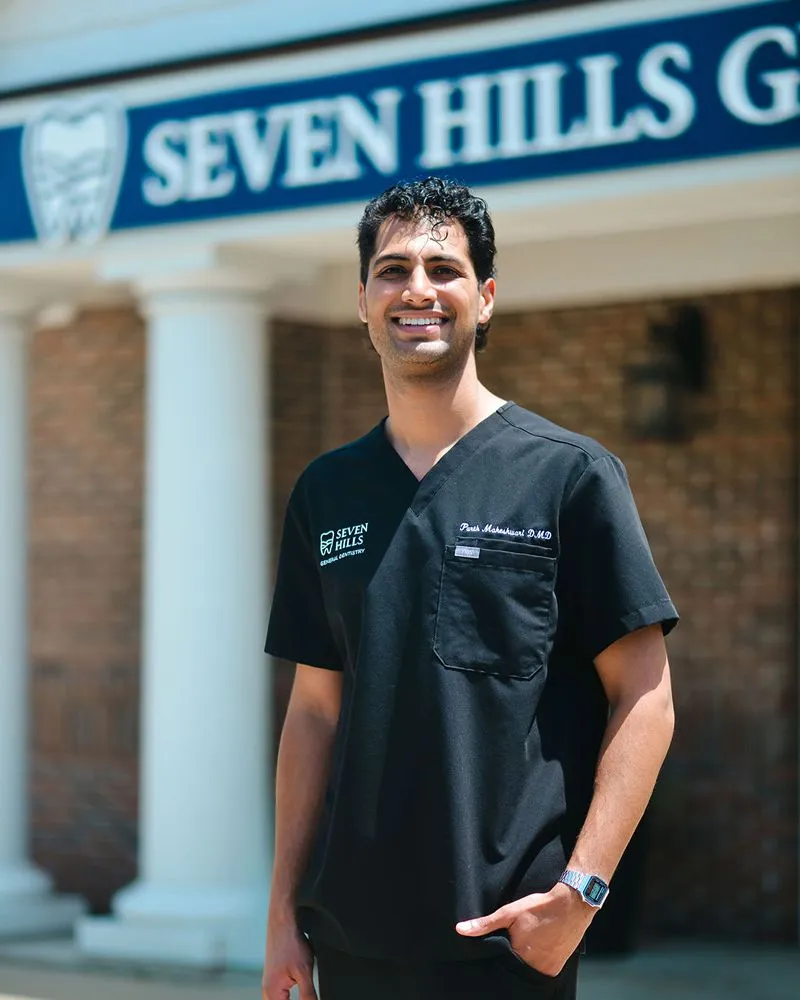
We fix chipped, cracked and broken teeth at Seven Hills General Dentistry, our office on Bridgetown Road in Cincinnati. Dr. Parth Maheshwari looks at the tooth first and picks the smallest repair that’ll hold, from smoothing a rough edge or bonding a chip to a filling or a crown. If you come in with a chip, we can usually bond it that same day.
Most chips happen on a normal day, usually from something small like a popcorn kernel or a fork. Then the questions start. We’ve answered them here in roughly the order people ask.
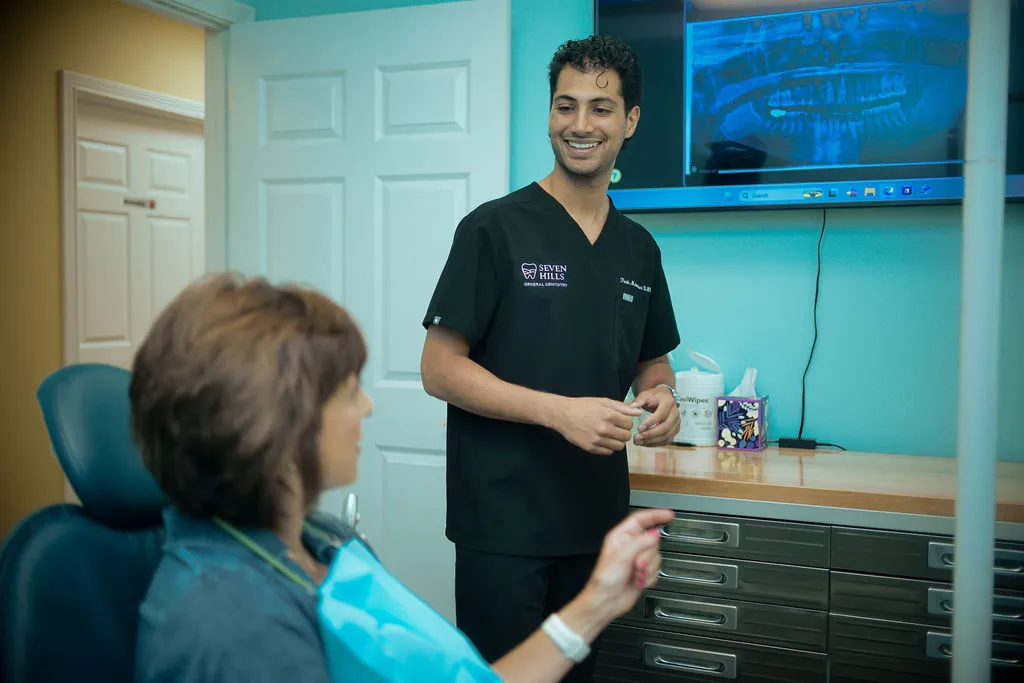
Most chipped teeth aren’t emergencies, but they still need a dentist because enamel doesn’t grow back. Pain that starts on its own, a pink or red dot in the break, swelling in your gum or face, or a big missing piece means calling us the same day. Trouble breathing or swallowing, swelling spreading fast toward your eye or neck, or feeling very sick with a fever means 911 or the ER first.
Small chips are often smoothed or bonded in one visit. Bigger breaks may need a veneer or a crown, and if the nerve is exposed or badly damaged, it may need a root canal first. Root canals are the one treatment Dr. Parth refers to a specialist, and he rebuilds the tooth here afterward. Taking the tooth out is the last thing we’d suggest.
Chipped a tooth? What to do in the next hour
Rinse with warm water. If your lip or cheek is swelling, hold something cold against the outside of your face. That’s what the American Dental Association recommends first for a cracked tooth.
Then look for the piece. If you find it, put it in a little milk and bring it along. Bonding the piece back on isn’t the usual fix, but sometimes it works.
Until you’re seen:
- Cover a sharp edge with orthodontic wax from the pharmacy, or a piece of sugar-free gum in a pinch, so it stops catching your tongue.
- Chew on the other side and stick to softer foods.
- Skip very hot and very cold drinks if the tooth feels sensitive.
- Take an over-the-counter pain reliever by the label if it aches. Never hold an aspirin against the gum, which the ADA warns can burn the tissue.
- Keep brushing and flossing gently so food doesn’t pack against the broken edge.
Please skip the superglue. It isn’t made for your mouth. And don’t file the edge down yourself, because it’s easy to take off more enamel than the chip did.
A whole adult tooth knocked out is a different dental emergency. Pick it up by the chewing surface, not the root, and try to set it back in the socket, or keep it in milk if you can’t. The American Association of Endodontists says to see a dentist within 30 minutes.
Is a chipped tooth an emergency?
Usually not. Your symptoms tell you how soon you need to be seen, and the table below covers the calls we get most.
| What you notice | How soon | What it may mean |
|---|---|---|
| Trouble breathing or swallowing, swelling spreading fast toward your eye or neck, or feeling very sick with a fever | Now: 911 or a hospital emergency room | A spreading infection, which a dental office can’t manage alone |
| A hard hit to the face, a jaw that may be broken, or you passed out | Now: a hospital emergency department | An injury beyond the tooth |
| A pink or red dot in the break, bleeding from the tooth, or aching on its own | The same day | The nerve may be exposed or inflamed |
| Swelling in your gum or face, without the signs in the first row | The same day | An infection may be starting around the tooth |
| A large piece gone, or the tooth feels loose or split | The same day | The break may run deep or below the gum |
| Pain when you bite down or let go | Within a few days | A crack may run further than the chip |
| Sensitivity to cold, sweets or air | Within a few days | The softer layer under the enamel may be exposed |
| A small chip with no pain | Within a week or two | Usually enamel only |
We see new patients of all ages, and we keep time in our schedule for emergencies and urgent problems, with same-day appointments whenever we can.
If we’re closed
We’re closed Friday through Sunday, and on Thursdays we close at 2:00 PM. If a “now” row happens while we’re closed, call 911 or go to a hospital emergency room. Otherwise, protect the tooth and send us an appointment request, and we’ll pick it up when we reopen Monday.
Check your chip in under a minute
Nothing you click here is saved or sent anywhere, and it can’t diagnose your tooth. That takes an exam, which can include a bite test, X-rays, photos, a bright light shone through the tooth and a 3D CBCT scan, because some cracks don’t show on regular X-rays.
Which repair fits your chip
Two things mostly decide the fix: how much tooth is gone, and where it is. A front tooth has to look right, while a back tooth has to handle your chewing. If the nerve’s involved, that gets treated first.
Smoothing a tiny chip
If only a sliver of enamel is gone, we can often just smooth and polish the edge so it blends in and stops catching your tongue. It’s quick, and it usually doesn’t need numbing.
Bonding, the usual fix
Bonding fills in the missing part with tooth-colored composite matched to your shade, then hardens it with a curing light. It’s usually one visit, often with little or no drilling, and it’s the most common fix for a chipped front tooth. When you come in with a chip, Dr. Parth can usually bond it that same day.
Our page on cosmetic dentistry in Cincinnati has more on bonding and how it stacks up against veneers.
Putting the broken piece back
Dr. Parth doesn’t usually bond a broken piece back on, but sometimes he can, if it was kept moist and still fits well. Bring it in either way.
Fixing a broken back tooth (molar)
Back teeth take your chewing force, and they often break around old fillings. If a cusp or a piece of the chewing edge breaks off, a tooth-colored filling can rebuild it when enough strong tooth is left, and otherwise it’s usually a crown.
When a big old filling breaks, the tooth may need a crown, depending on how much strong tooth is left, and a break that runs below the gum may need a root canal (we refer those to a specialist) or removal.
Veneers for bigger chips up front
A porcelain veneer is a thin lab-made shell bonded over the front of the tooth, usually across two visits. It’s a good fit for a bigger chip on a front tooth, especially if you’d also like to change that tooth’s color or shape.
The catch is that a thin layer of enamel has to come off, and it doesn’t grow back, so we look at bonding first. See how bonding and veneers compare on our cosmetic page.
Crowns for big breaks
When a big part of the tooth is gone, especially on a back tooth, a crown covers the whole thing and holds what’s left together.
Here, a crown is two visits. The first takes about an hour and a half and you leave with a temporary, and the second takes about 20 minutes. Nearly every crown Dr. Parth places is zirconia because it’s strong and looks natural, and gold is available for a separate fee.
If the break reaches the nerve
If the nerve is exposed or badly damaged, it may need a root canal before the tooth is rebuilt. The usual clues are a pink dot in the break or pain that starts for no reason.
Root canals are the one treatment Dr. Parth refers out. He’ll send you to a root canal specialist (an endodontist), then rebuild the tooth here afterward, most often with a crown.
When a tooth can’t be saved
Some breaks split the tooth or run below the gum line, and a repair there won’t hold.
If that’s the case, Dr. Parth takes the tooth out and places dental implants right here, so planning the replacement starts in the same chair. A bridge is the other option, and he’ll walk you through the tradeoffs.
Chipped tooth repair options compared
| Option | When it usually fits | Worth knowing |
|---|---|---|
| Smoothing and polishing | A tiny chip in enamel only | A few minutes, usually no numbing |
| Bonding | Most small and medium chips, especially on front teeth | Usually one visit with little or no drilling; can stain or chip over time and be touched up |
| Reattaching the fragment | A clean break where the piece was saved and kept moist | Not the usual fix, but sometimes possible; bring the piece in milk |
| Tooth-colored filling | A small missing corner on a back tooth | Works when enough strong tooth surrounds it |
| Porcelain veneer | A larger chip on a front tooth, or a tooth you also want to reshape or recolor | Usually two visits; a thin layer of enamel is removed for good |
| Crown | A large break, a back tooth, or a tooth weakened by an old filling or root canal | Two visits here; covers and braces the whole tooth |
| Root canal, then a crown | The nerve is exposed or badly damaged | We refer the root canal to a specialist, then rebuild the tooth here |
| Removal, then an implant or bridge | A tooth split or broken below the gum that can’t be repaired | Removal and implants are done here, only when the tooth can’t be kept |
The crack you can’t see
The chip is the part you can see. Whether a crack runs deeper into the tooth matters just as much, and that’s easy to miss.
The American Association of Endodontists sorts cracks by depth:
- Craze lines are tiny surface lines in enamel that cause no pain and are only a cosmetic concern.
- A fractured cusp is a broken-off piece of the chewing surface, often around a filling, that rarely damages the nerve.
- A cracked tooth has a crack running from the chewing surface down toward the root, and it can spread over time.
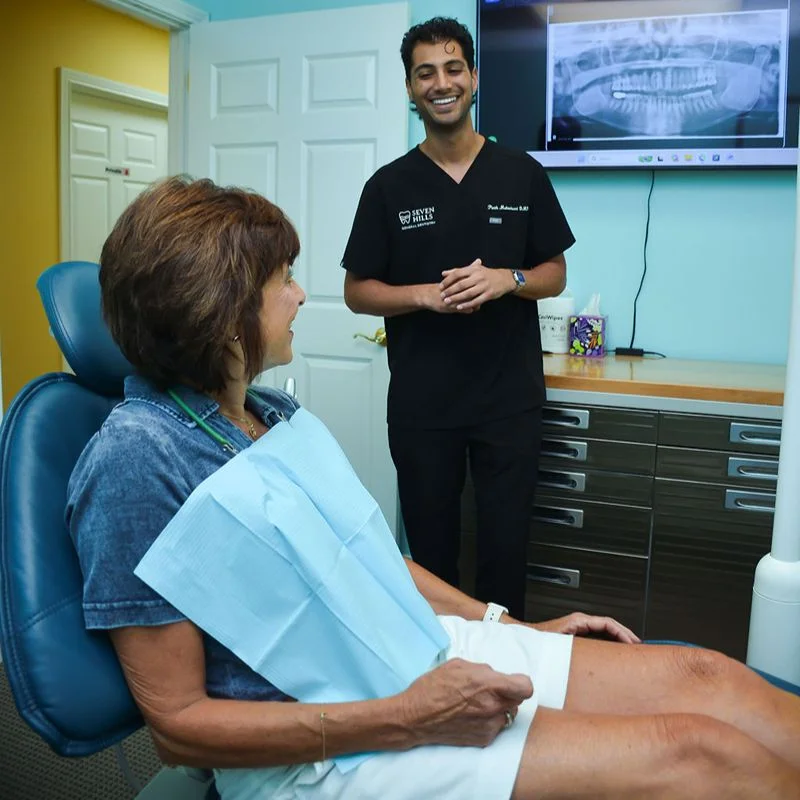
The AAE also points out that a cracked tooth won’t heal the way a broken bone does. So before we bond over a chip, Dr. Parth checks it for cracks. Depending on the tooth, that can mean a bite test, X-rays, photos, shining a bright light through the tooth (transillumination) and a 3D CBCT scan. Some cracks don’t show up on regular X-rays, and bonding over a hidden one can leave the real problem in place.
If it hurts when you bite down and let go, mention it when you call. That’s a classic sign of a crack.
When we’d tell you to leave it alone
Not every chip needs fixing. Once we’ve had a look, a tiny chip on the edge of a front tooth that doesn’t catch your tongue, or craze lines you only notice up close, can often just be left alone. If it bugs you to look at, smoothing or a little bonding is always an option.
A few things people try first that usually aren’t the right move:
- Whitening to hide a chip. Whitening changes shade only. It won’t fix a missing piece, and bonding placed afterward has to be matched to the new shade.
- Veneers on several teeth for one chip. One chipped tooth can usually be fixed on its own.
- Drugstore repair kits as the fix. Temporary filling material can cover a sharp edge for a few days, but it doesn’t rebuild the tooth or show whether there is a crack.
- Waiting out a tooth that hurts. Pain that fades on its own doesn’t always mean the tooth settled. The nerve can be dying while the pain eases, so a painful chip still needs a look.
What a chip repair visit at Seven Hills looks like
Tell us what happened
Let us know what broke, if it hurts, and if you saved the piece. That way we book enough time.
Exam and crack check
Dr. Parth looks at the tooth and gum, has you bite down to test for a crack, and takes X-rays and photos. He can also shine a bright light through the tooth or take a 3D CBCT scan, since some cracks don’t show on regular X-rays.
Your options and the cost, before anything starts
We put the X-ray and photos up on the screen and go through your options, including what each one should cost after insurance.
The repair
For bonding, Dr. Parth matches the shade, lightly preps the surface, and builds the composite up in layers, hardening each with a light before shaping and polishing. Most bonding is done that same visit.
Bigger repairs are scheduled
A crown or veneer means a second visit with a temporary in between. If the nerve needs a root canal first, you’ll know that up front, and we’ll refer you to a specialist.
What chipped tooth repair feels like
Smoothing and small bonding repairs often don’t need numbing, since the work stays in the enamel. Deeper chips, or ones close to the nerve, get numbed first. Most people feel pressure and some vibration, but not pain. We don’t offer sedation, but nitrous oxide (laughing gas) is available if you’re nervous.
A bonded tooth usually feels normal once the numbness wears off. After a deeper repair, some cold sensitivity is common and tends to settle within days. If your bite feels high, or the ache gets worse instead of better, give us a call.
With a crown, the tooth is numbed before it’s prepped, and it may be a little sore for a few days. Until the final crown is in, chew on the other side and skip sticky foods.
Why did it chip?
If we don’t fix the reason it chipped, the repair can chip too. The usual causes:
- Grinding or clenching. It wears edges thin and can break bonding, too. A custom night guard, which Dr. Parth has made by a dental lab, protects your teeth, but it doesn’t explain why you grind at night, so Dr. Parth may ask about your sleep and breathing. Our sleep apnea treatment page covers that.
- Large old fillings that leave thin walls of tooth around them.
- Decay that weakens the tooth from the inside.
- Acid from reflux, frequent soda, or sour candy, which softens enamel over time.
- Hard foods and habits: ice, popcorn kernels, hard candy, pens, and opening packages with your teeth.
- Sports without a mouthguard. We can have a custom sports mouthguard made for you.
Age plays a part, too. Cleveland Clinic notes that teeth chip more easily after 50, after decades of wear on the enamel.
Does insurance cover chipped tooth repair?
Often, at least in part. Fixing a chipped or broken tooth restores how it works, so dental plans often pay toward it, the same way they do for a crown on a cracked tooth. Work done only for looks generally isn’t covered, and what your plan pays depends on its deductible, annual maximum and any waiting period.
We take many insurance plans. We’ll check your benefits before you come in and file the claim for you, and nothing starts until you’ve seen the full cost and your estimated copay.
The total depends on the size of the break and which repair it needs. A crack or nerve that needs treatment first adds to it, and so does choosing gold for a crown.
How much does it cost to fix a chipped tooth?
Smoothing and bonding usually cost the least, and a filling costs about the same or a bit more. Veneers, crowns, root canals and implants cost more. You’ll get the exact cost after the exam, before any work begins.
No insurance? Ask about our in-house wellness plan. Financing is available for larger treatment plans.
Your dentist on Bridgetown Road
Dr. Parth Maheshwari, DMD, owns Seven Hills General Dentistry and provides general, restorative, cosmetic, and implant dentistry here.
He earned his dental degree at Southern Illinois University School of Dental Medicine, then spent four years in California training in dental implants, bone grafting, and full-mouth reconstruction under Dr. Ryan Dunlop. He is licensed to practice dentistry in Ohio and California.
For a broken tooth, that means nearly everything, from a quick polish to an extraction or an implant, happens in one office. Root canals are the one thing he refers to a specialist. He’ll still start with the smallest fix that’ll hold.
We schedule enough time to go over your X-rays with you and answer questions without rushing. Read Dr. Parth’s full background.
What patients say about Seven Hills
You can read more from our patients on our reviews page.
Chipped tooth repair on Cincinnati’s West Side
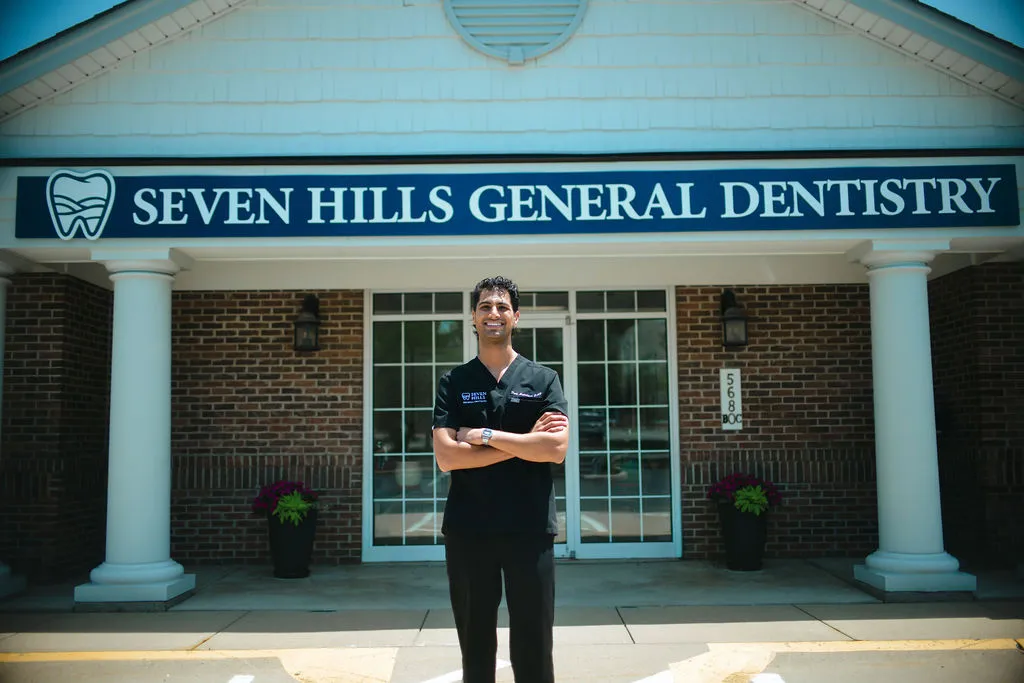
Our office is at 5680 Bridgetown Road in Bridgetown, in the same building as The Christ Hospital Physicians. We’re on the north side of Bridgetown Road, a few blocks west of Race Road, next to First Financial Bank, with a parking lot right in front. The entrance, parking and restroom are wheelchair accessible.
Patients come to us from Green Township, Cheviot, Monfort Heights, Western Hills and Dent. Directions are also on our contact page.
Monday to Wednesday 8:00 AM to 5:00 PM, Thursday 8:00 AM to 2:00 PM, closed Friday to Sunday. Seven Hills General Dentistry, 5680 Bridgetown Rd, Cincinnati, OH 45248.
Chipped tooth questions
Will a small chip get bigger if I leave it?
Sometimes. A thin, sharp edge can keep breaking, especially if you grind or chew on nails or pens. A tiny smooth chip often stays the same for years, and a quick check in the next week or two will tell you which kind you’ve got.
How long does bonding on a chipped tooth last?
Usually for years. Composite is softer than enamel or porcelain, though, so it can stain or chip and eventually need a touch-up or a redo. Nail biting, chewing ice and grinding without a night guard wear it out fastest.
Can the broken piece be glued back on?
Sometimes, though it isn’t the usual fix. If the piece is clean, was kept moist (milk is best) and still fits well, Dr. Parth may be able to bond it back on. If not, we rebuild that part with composite, so bring it in either way.
Can a chipped front tooth be fixed in one visit?
Often, yes. When you come in with a chip, we can usually bond it that same day. Veneers and crowns take two, with a temporary in between.
Will the repaired tooth look natural?
It should. The shade is matched to the teeth next to it, and the edge of the bonding is blended and polished so you don’t see a line. If looks are your main worry, tell Dr. Parth, since matching one front tooth to its neighbors takes extra care.
Should I whiten my teeth before fixing a chipped front tooth?
If you were already thinking about whitening, do it first. Bonding is matched to your teeth as they are now, and whitening won’t lighten it later. Whiten afterward and the repair can end up darker than the teeth around it.
Why did my tooth chip when I was eating something soft?
Usually the tooth was already weak from a big old filling, decay, grinding or acid wear, and that soft bite just finished the job. Figuring out the cause is part of the exam. It tells us whether bonding will hold or a crown is the safer bet.
What if my child chipped a tooth?
Rinse their mouth, put the piece in milk and call us, since we see patients of all ages. A chipped baby tooth still deserves a look, especially after a fall, because the injury can affect the nerve or the adult tooth growing underneath. Don’t push a knocked-out baby tooth back into the socket.
Can you fix a chip in a crown or veneer?
Sometimes. A small chip in porcelain can occasionally be smoothed or patched with composite. Bigger chips usually mean replacing the crown or veneer, depending on the tooth underneath.
Can a chipped tooth get infected?
It can, if the break reaches the inside of the tooth and bacteria get in. Pain when you chew, sensitivity to hot or cold that lingers, a bad taste, or swelling in your gum or face means calling us the same day for an urgent visit. Trouble breathing or swallowing, swelling spreading fast toward your eye or neck, or feeling very sick with a fever means 911 or the ER first.
Do you do root canals and extractions here?
Dr. Parth removes almost all teeth here, though a few tricky wisdom teeth go to a specialist. Root canals are the one treatment he refers out, to a root canal specialist (an endodontist), and then he rebuilds the tooth here, usually with a crown.
More answers are on our FAQ page.
Have the chip checked in Bridgetown
You don’t need to know which repair you want. Just tell us what happened when you request a visit, and we’ll book the right amount of time with Dr. Parth.
Seven Hills General Dentistry, 5680 Bridgetown Rd, Cincinnati, OH 45248
Sources
- American Dental Association, MouthHealthy: Dental Emergencies
- American Association of Endodontists: Cracked Teeth
- American Association of Endodontists: Knocked-Out Teeth
- Cleveland Clinic: Chipped Tooth